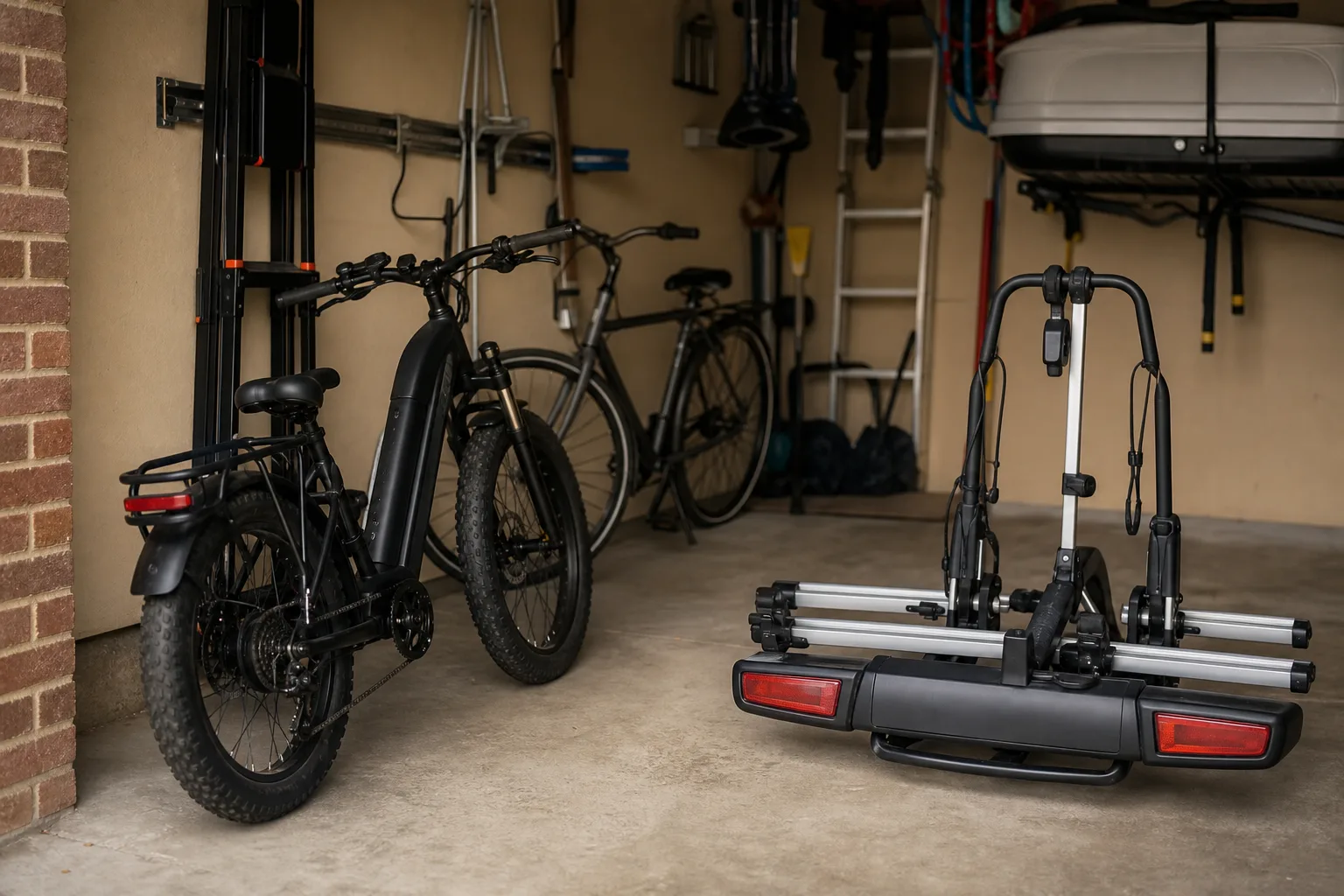
A conventional commuter bicycle in a shop window weighs somewhere around twenty-five to thirty pounds, and almost every habit an experienced rider has, lifting it onto a rack, carrying it up a half flight of stairs, dragging it sideways out of a bike room, was formed against that number. An electric version of the same machine, with a hub or mid-drive motor, a controller, wiring, heavier wheels and a battery holding several hundred watt-hours, commonly lands near fifty or sixty pounds. That is not a specification detail. It is the single change that reorganizes the rest of the decision, including several things that look unrelated to weight on the sales floor.
Where the extra fifty pounds actually shows up
It shows up in the places a test ride does not test. On the road, at speed, a heavier bike feels planted and pleasant, and the motor erases the weight penalty on every climb. Off the road it is a different object entirely. A fifty-five pound bike does not go on a trunk-mounted car rack rated for lighter loads, does not get carried up an apartment stoop one-handed with groceries in the other, and does not get lifted onto a bus rack by most riders without a plan. Storage above ground floor becomes a real question, and so does the answer to what happens when the battery is empty three miles from home.
The costs attached to that weight are ordinary and predictable. A hitch rack rated for e-bikes, a ramp for a basement, a heavier lock because the bike is worth more and steals better, and tires and brake pads that wear faster because there is more mass to stop. Removable batteries help, since pulling seven or eight pounds off the frame makes the bike easier to carry and lets the pack charge indoors, away from an unheated garage. That single feature is worth more in daily life than most of the numbers printed on the spec card.
Speed classes are a legal category, not a performance tier
Most states have adopted a three-class framework. Class 1 is pedal assist only, cutting out around twenty miles per hour. Class 2 adds a throttle at the same cutoff. Class 3 is pedal assist to roughly twenty-eight miles per hour, often with a required speedometer and, in many jurisdictions, a minimum rider age and restrictions on where it may be ridden. The class sticker matters less for how fast the bike feels and more for which paths, trails and bike lanes are open to it, and whether a local park district or transit agency will let it through the gate. A Class 3 machine that is barred from the rail trail a rider actually uses is the wrong purchase at any price.
Federal product rules define a low-speed electric bicycle by motor output and top assisted speed, and the Consumer Product Safety Commission is the agency responsible for that consumer product category. Battery and charger safety certification, usually a UL listing on the pack and the charger, has become the other thing worth checking, because building insurers, landlords and some municipalities have started asking about it directly. Ask for the listing in writing before buying, not after.
Which ordinary bicycle instincts still hold
Fit does. Standover height, reach, saddle height and the distance from saddle to bar are exactly as important as on an unpowered bike, and slightly more consequential, because a rider who cannot get a foot down flat is now managing a heavier machine at a stop. Step-through and low-standover frames are common in the category for that reason, which is also why shopping the aisle labeled womens ebikes tends to surface geometry choices rather than anything intrinsically gendered: lower top tubes, shorter reach, narrower bars, and saddles shaped for a wider range of sit bone spacing. Judge those parts on measurements, not on the label above them.
Gearing still matters, because a motor that cuts out at twenty miles per hour leaves the rider pedaling unassisted above that. Brake choice still matters, more than before: hydraulic disc brakes with four-piston calipers are not an upgrade on a fifty-five pound bike carrying a passenger or cargo, they are the appropriate part. Tire volume, fender clearance, rack mounts and a kickstand that can hold the loaded weight are all the same considerations a good commuter bike always had, scaled up.
What the decision costs across three years
The purchase price is the visible number and the least interesting one. Chains, cassettes, brake pads and tires wear at something closer to motorcycle intervals than bicycle intervals, and a shop that services e-bikes charges labor accordingly. Batteries lose usable capacity gradually with charge cycles and calendar age, so the range figure quoted at purchase is a starting condition, not a constant, and a replacement pack is one of the larger single expenses in the ownership arc. Knowing the replacement price and confirming the pack will still be sold in four years is a five-minute question that changes which bike is the cheaper one.
Set against that, the running cost of electricity is trivial, a few cents a charge, and a bike that replaces car trips pays back in parking, fuel and mileage faster than the spreadsheet suggests. The purchase worth making is the one where the weight fits the building, the class fits the routes, and the frame fits the rider.