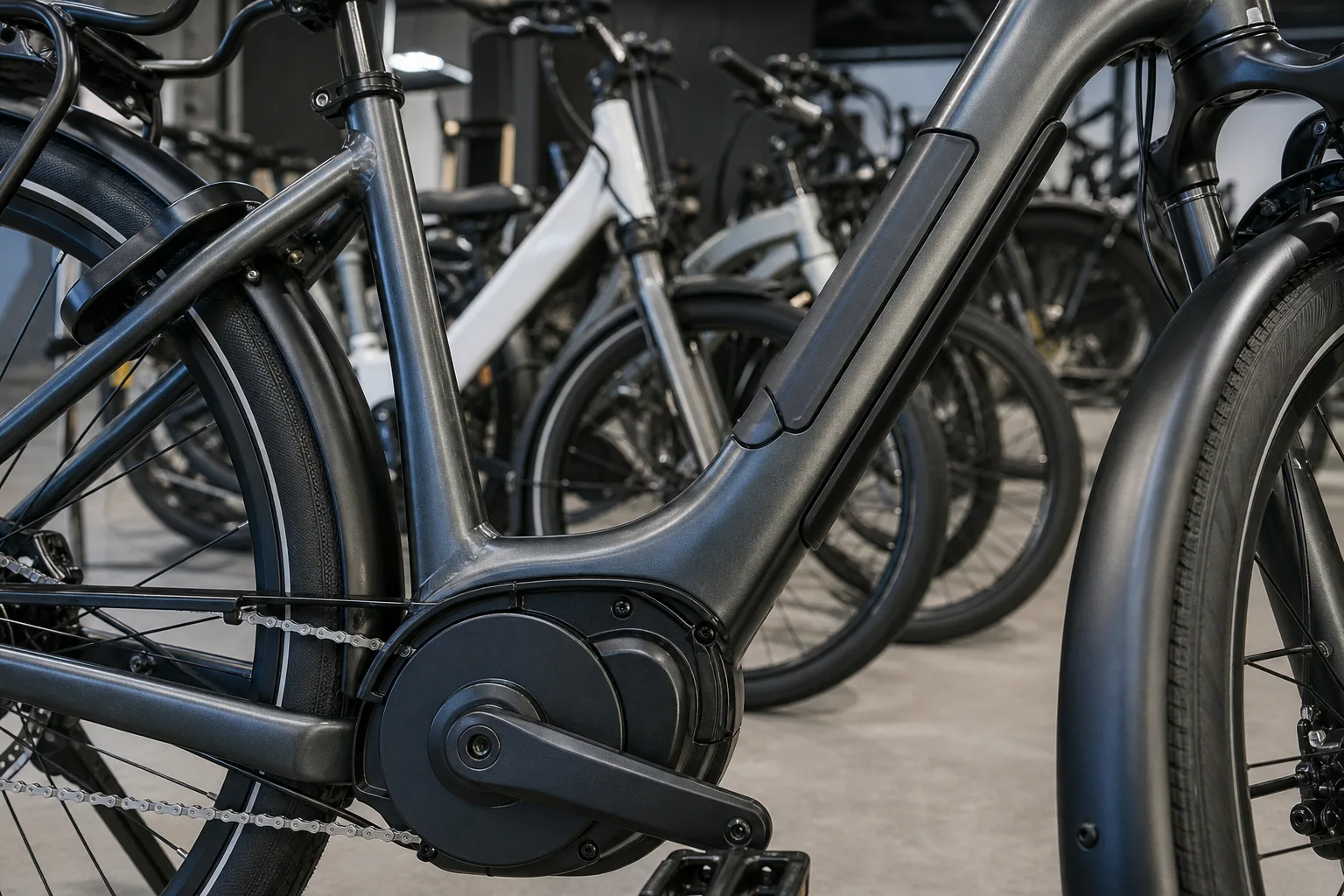
Open two product pages from the same manufacturer, one labeled men's and one labeled women's, and the differences are rarely mysterious once you look past the paint. In most catalogues the gendered label is shorthand for a bundle of four changes made together: a dropped or removed top tube, a slightly shorter reach, narrower handlebars, and a saddle with a wider, shorter shell. Sometimes there is a fifth, shorter crank arms. None of those changes is inherently gendered, and each of them is available separately if you know what to ask for. The label is a merchandising decision. The geometry chart is the product.
What the label is actually describing
The frame drop is the visible part. A step-through, low-step, or trapeze frame lowers or eliminates the top tube so the rider swings a foot through rather than over, and on an electric bicycle carrying twenty extra pounds of motor and battery that matters more than it does on a lightweight road frame. The reach change is usually modest, on the order of ten to twenty millimeters, achieved with a shorter top tube or a shorter stem. Narrower bars follow from average shoulder width assumptions. The saddle is swapped for one built around wider sit bone spacing. Four decisions, one name.
Treat each one separately and the shopping problem simplifies. Bars and saddles are consumables that any shop will change during the first fitting, often at little or no cost if you buy the bicycle there. Stem length is a ten minute job. Crank length is a parts order. Frame geometry is the only element you cannot revise after purchase, which means the frame is the only part of that bundle worth agonizing over before the money moves.
Reading stack, reach, and standover
Stack is the vertical distance from the bottom bracket to the top of the head tube, and reach is the horizontal distance between the same two points. Together they describe the space the rider occupies, independent of stem, bars, and seatpost, which is why fitters use them and why marketing copy usually does not. A higher stack with a shorter reach produces the upright, hands-high position most commuters want in traffic. A lower stack with a longer reach stretches the rider forward. Two frames sold as different sizes may share a reach number and differ only in stack, which is a saddle height problem, not a fit problem.
Standover height is the third number, measured from the ground to the top tube at roughly the frame's midpoint, and it answers one narrow question: can you stand flat-footed astride the bicycle without contact. Manufacturers measure it at different points along the tube, so compare it against your own inseam with a margin rather than treating a one centimeter difference between two brands as meaningful. On a step-through the number is often so low that it stops being a constraint at all, which frees the rest of the fit to be chosen on comfort rather than clearance.
Why step-throughs suit riders who are not short
The riders who benefit most from a low step are often tall. Anyone with a hip replacement, a stiff lower back, a pannier full of groceries, or a child seat mounted behind the saddle has to get a leg over a loaded rear end, and that is the maneuver that produces awkward moments at intersections. Riders who mount and dismount forty times on a delivery shift choose step-throughs for the same reason. Long skirts, work trousers, winter coats, and cargo racks all favor the same frame. Height has very little to do with it.
The old objection was stiffness. Removing a top tube removes structure, and early step-throughs flexed. Current designs answer that with larger diameter down tubes, often shaped around the battery, and with reinforced junctions at the head tube and bottom bracket. The Consumer Product Safety Commission oversees bicycle safety standards in the United States, and frame strength testing is a routine part of what reputable manufacturers document. A well-built low-step e-bike from a serious maker does not feel vague underneath you, and the test ride will tell you within a mile.
What a careful reader checks before paying
Ask for the geometry chart, not the size chart. Compare stack and reach against a bicycle you already ride well, since your own history is better evidence than any height range table. Confirm standover with shoes on. Then ask which of the bars, saddle, stem, and cranks the shop will swap as part of the sale, and get the answer in writing on the invoice. That conversation, more than the model name, determines whether the bicycle fits you in month six.